Legumes, made simple.
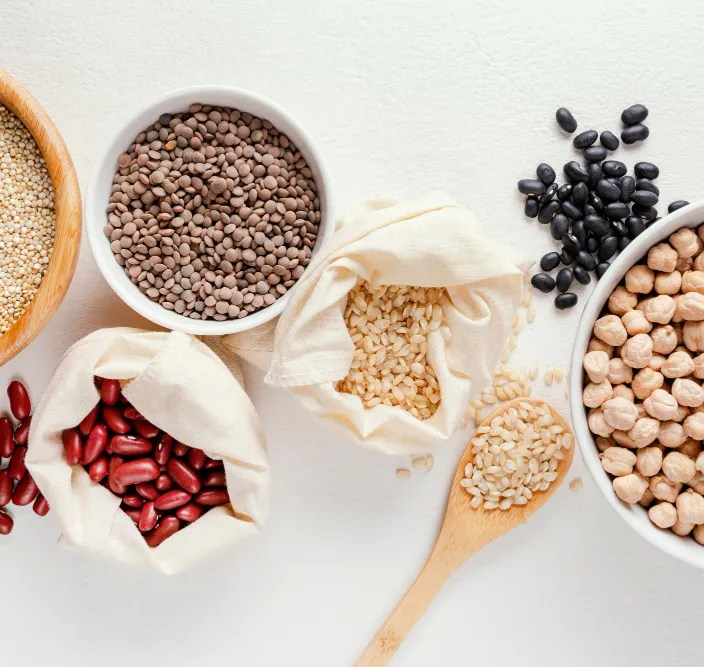
Legumes and cereals are healthy, affordable and local, but few people know how to prepare them. Two kitchen devices make it simple.
- Type
- Product design · Kitchen appliances
- Context
- Degree thesis, Industrial Design · Universidad Nacional del Litoral · 2018 – 2019 (14 months)
- Team
- Carla Beherens & Paula A. Velazquez (we worked on every stage together)
- Methods
- Fieldwork · Empathy map · Market and product analysis · SWOT · Product Development Strategy (PDS) · 3D-printed prototype
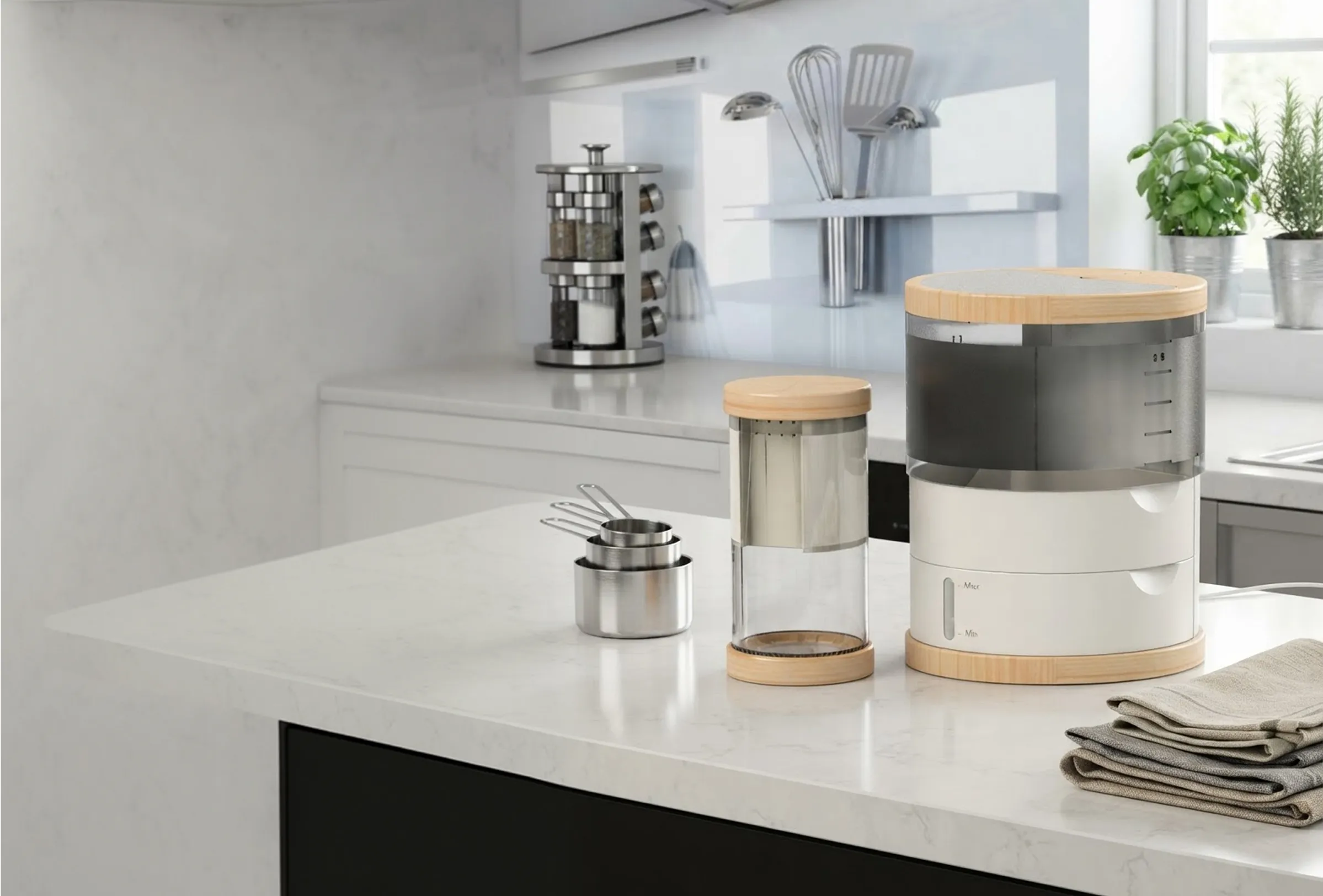
- 2 devices, 1 product family
- Designed for 30,000 units
01Overview
Our thesis explored how legumes and cereals are consumed in Argentina and how design could help people eat more of them. The result is a family of two kitchen devices that simplify the traditional techniques that make these foods easier to digest and more nutritious: activation, germination and microgreens.
Three stages
- 1ResearchKey concepts, users, context and market
- 2Creative stageIdeation and concept
- 3Detailed proposalUse sequence, functioning and detailed definition
02Context & problem
People who want to eat better often feel lost with legumes and cereals: they don’t know the techniques, preparation times, recipes or nutritional values.
Barriers we found
- PsychologicalUltra-processed foods dominate advertising. Children in Argentina are exposed to more than 60 ads for unhealthy food every week.
- Social and culturalLegumes are linked to long cooking times, cold days and “food for the poor”. Supermarkets offer very little variety.
- NutritionalTime is the biggest barrier, and traditional techniques that improve nutritional value are unknown.
- LifestyleAn urban society with less and less time for cooking.
Sources: FAO (2016), Argentine Ministry of Health (2017), fieldwork (2018).
03Research
Immersive fieldwork
To understand our users, we went where they are: food events, talks and workshops. We interviewed and surveyed people, and tried the new eating habits ourselves.
Market and product analysis
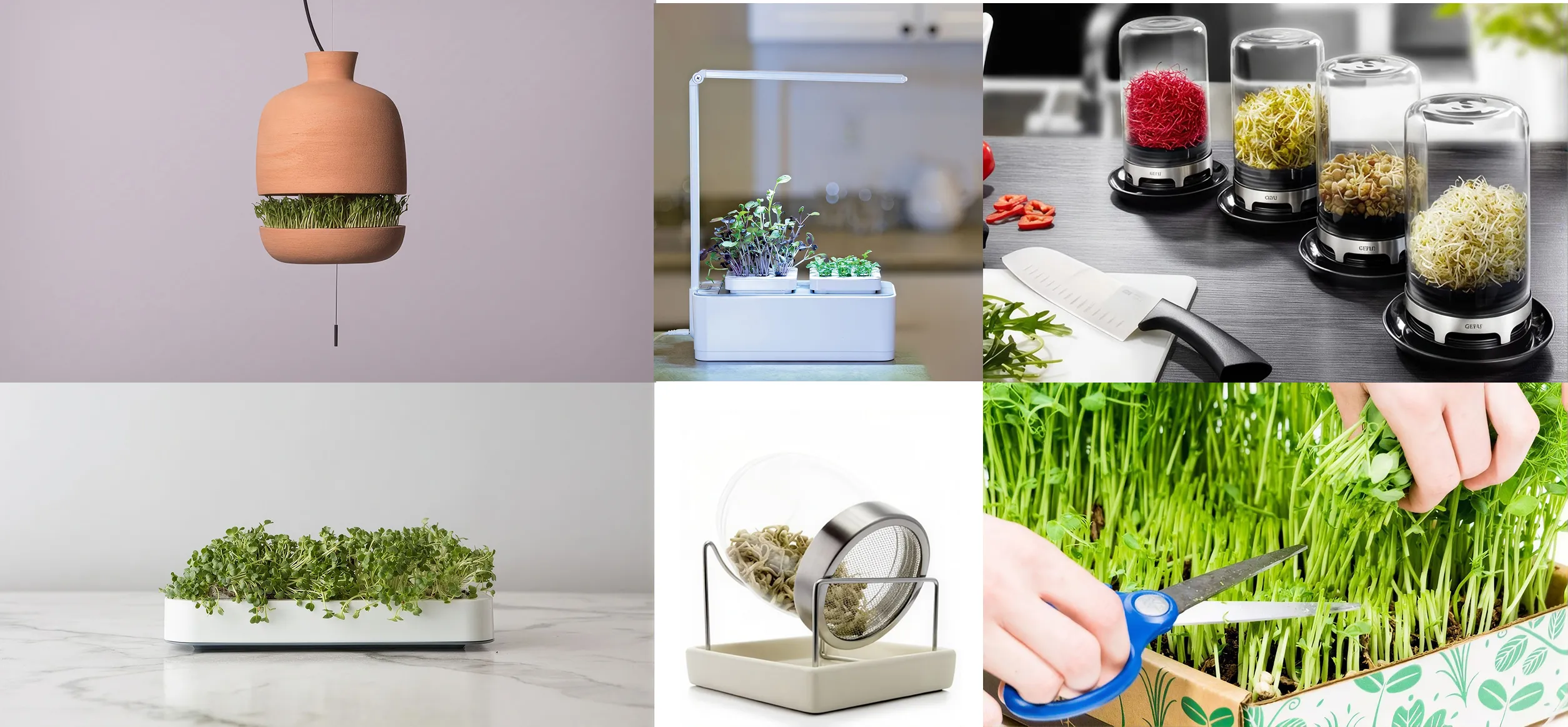
In Argentina, there were no products that combined several of these processes. Only early prototypes existed. We analyzed international germinators following Aquiles Gay’s method “La lectura del objeto”: function, form, structure, construction and use.
SWOT
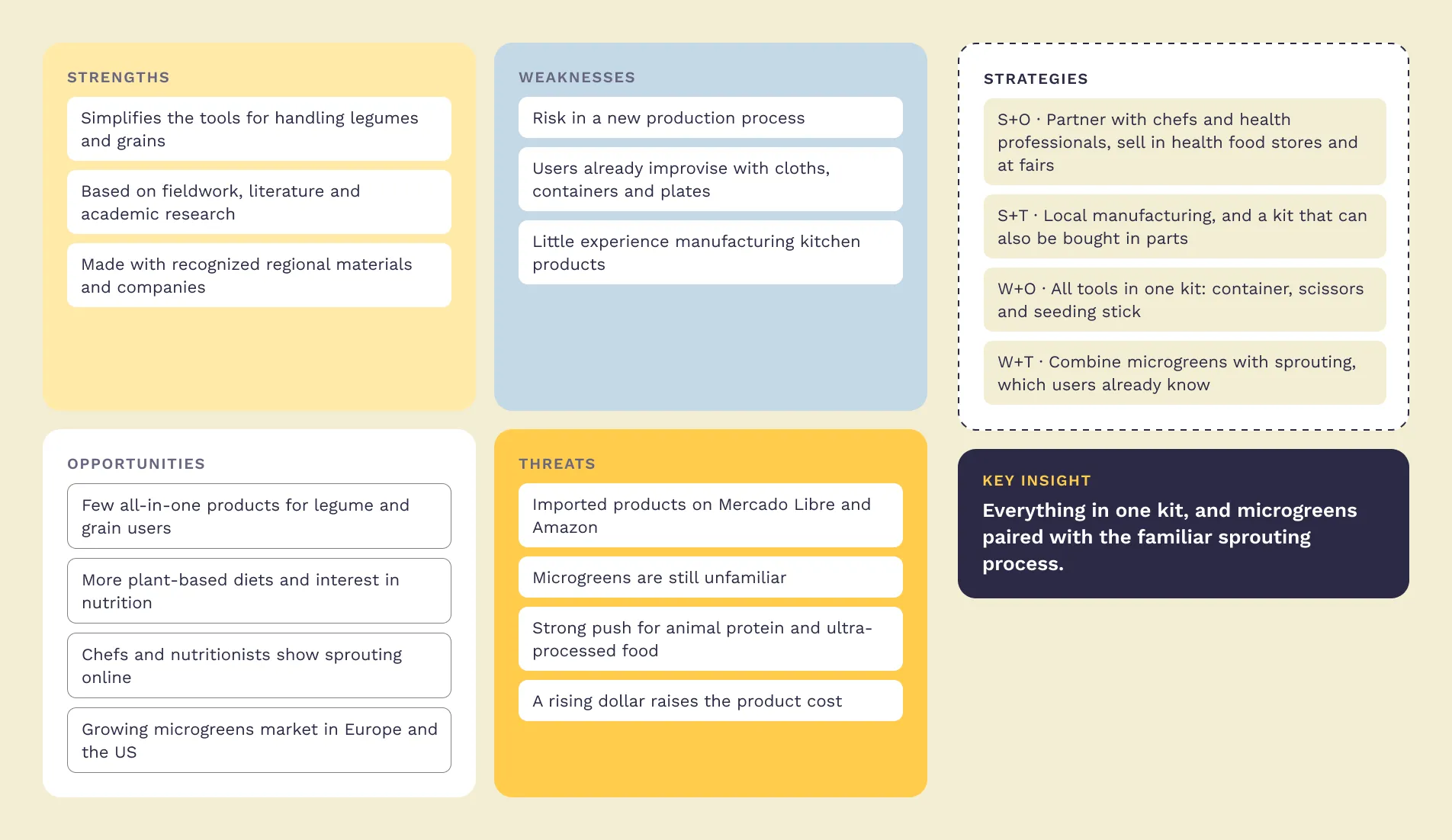
The biggest opportunity: almost no products offered an integrated solution, while plant-based diets, interest in microgreens and words like “natural” and “organic” were growing fast.
04Users & context of use

Interested in how diet affects health, worried about the food industry’s influence, finds recipes on social media and consults nutritionists. Wants to balance their diet and add unprocessed foods.
People with a plant-based diet (5% of the population). Already familiar with activation, germination and microgreens. Demanding consumers who want to diversify their diet.
From distrust to confidence
They question, research and look for answers.
They share information, meet like-minded people and talk about their experience.
The kitchen
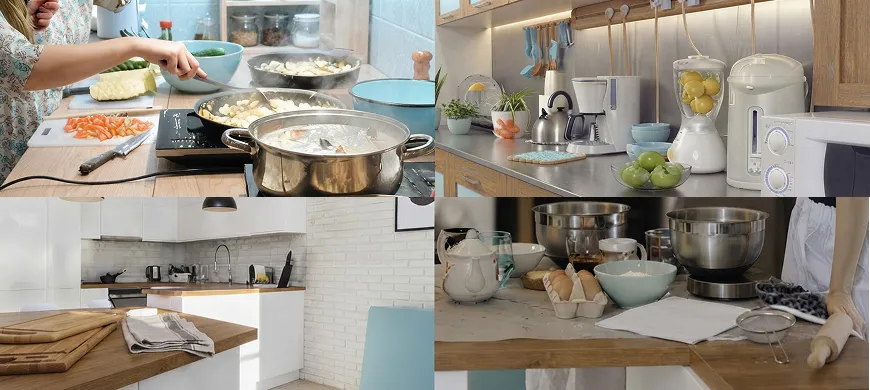
Our users live alone or with one or two people, in small apartments where kitchen, dining and living room share one space. The kitchen has two moments: an organized one, and a cooking one, when appliances come out and space shrinks. Its verbs are hang, store and keep. This shaped the form of our products: compact, cylindrical and easy to move with one hand.
05Concept
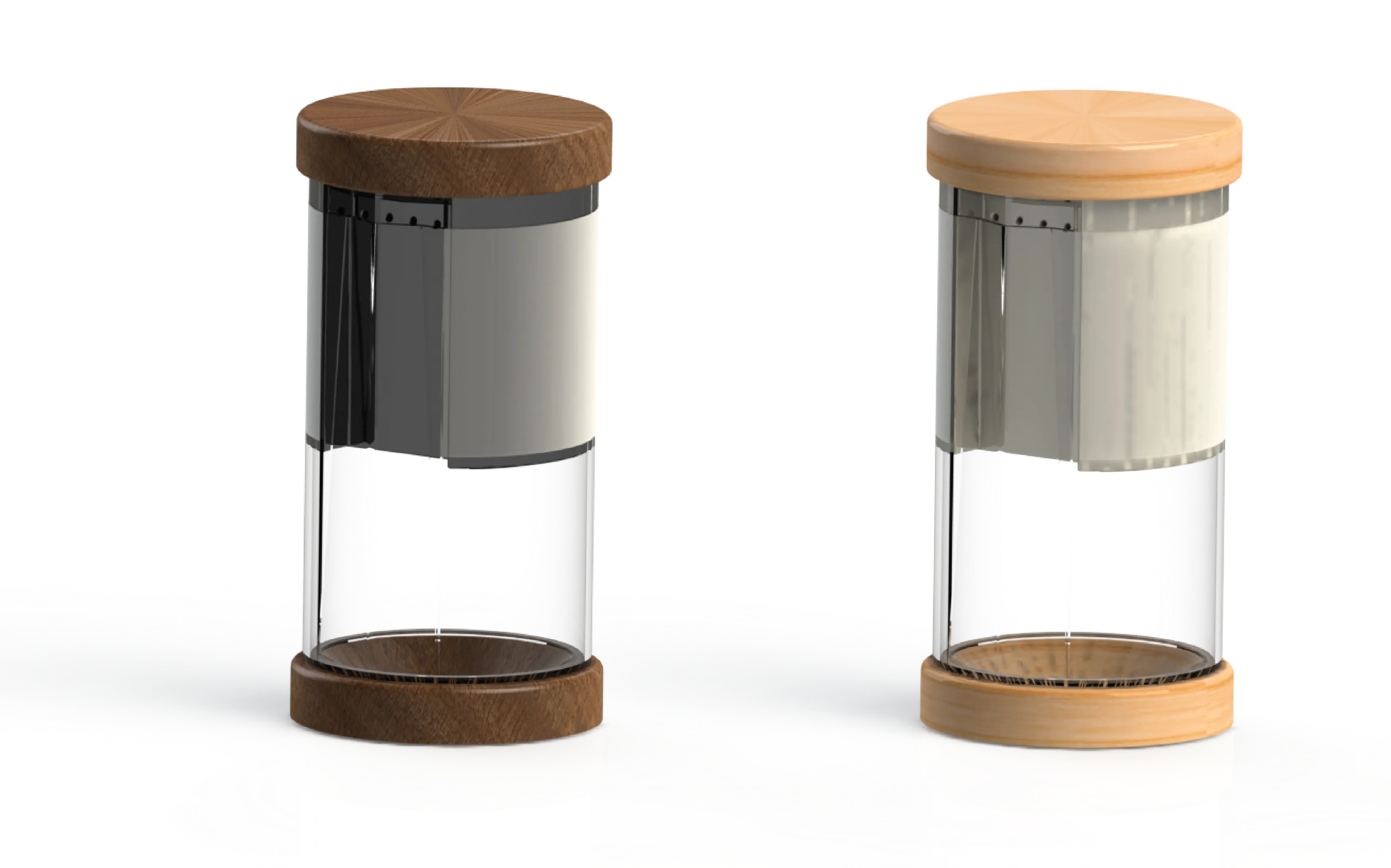
Two devices, one product family. In both, the legume or cereal is the protagonist and water is the key to the process. Transparent parts let you see what water is doing.
Product A · Activation
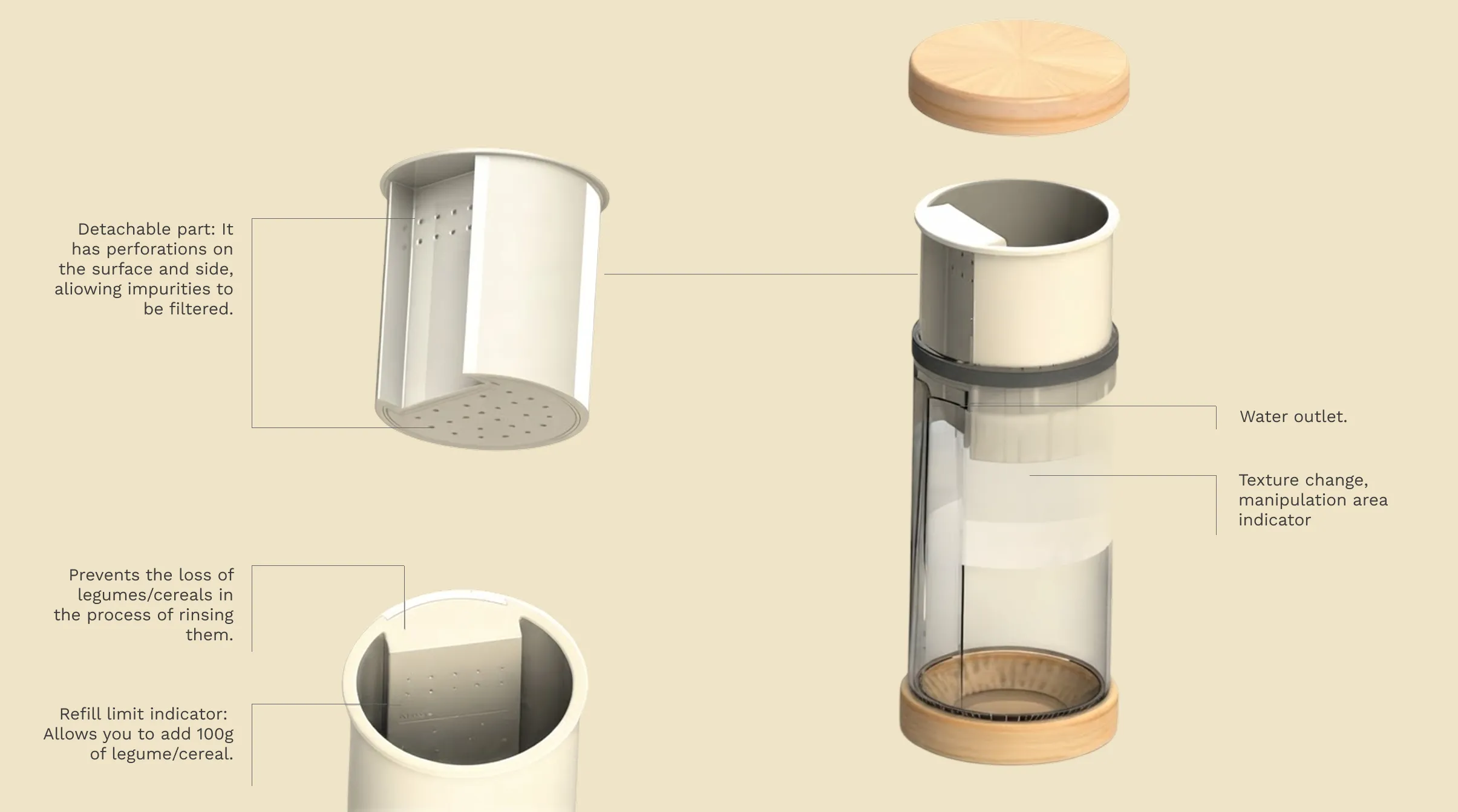
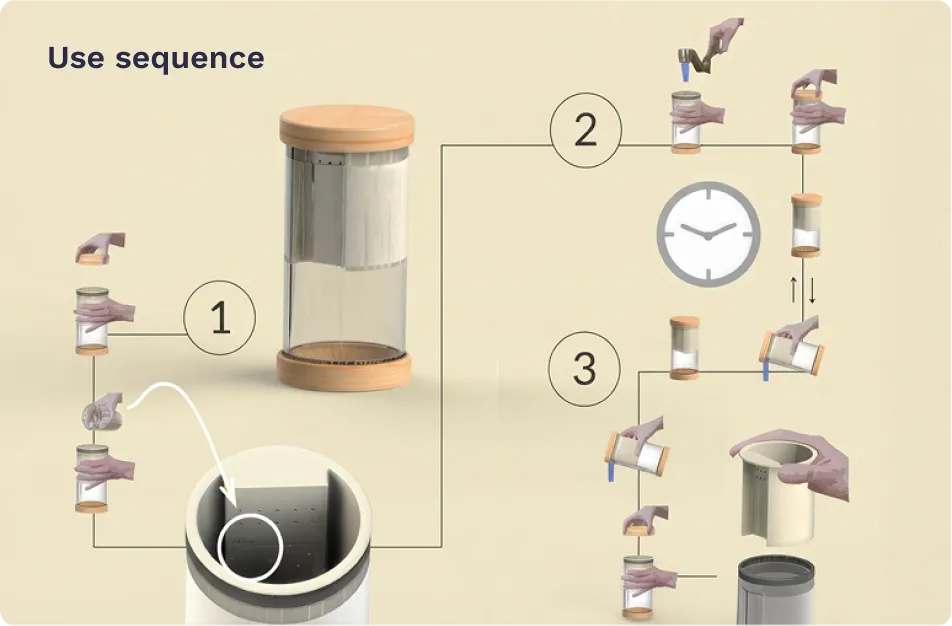
The food is soaked so impurities are released, then filtered and rinsed 2–3 times with the built-in strainer. Pressurized water cleans and hydrates.
Product B · Germination and microgreens
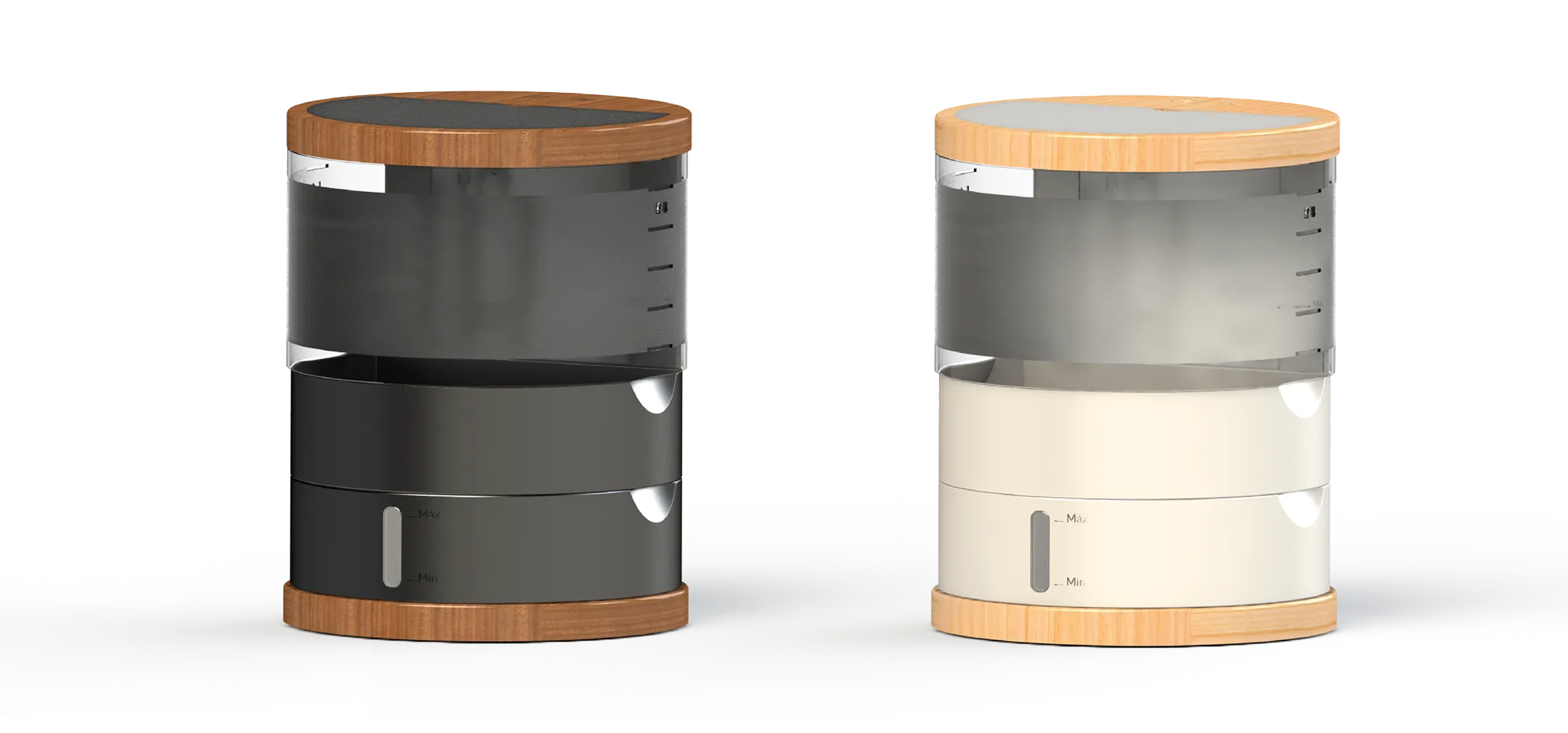
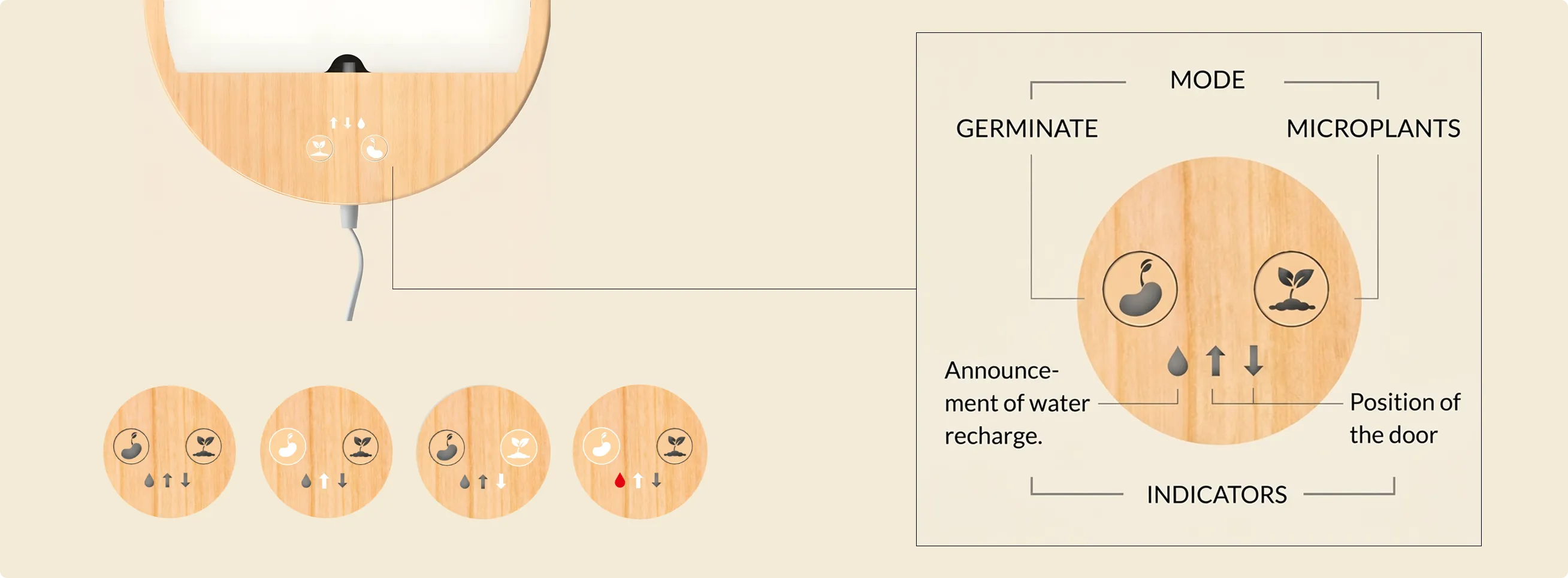
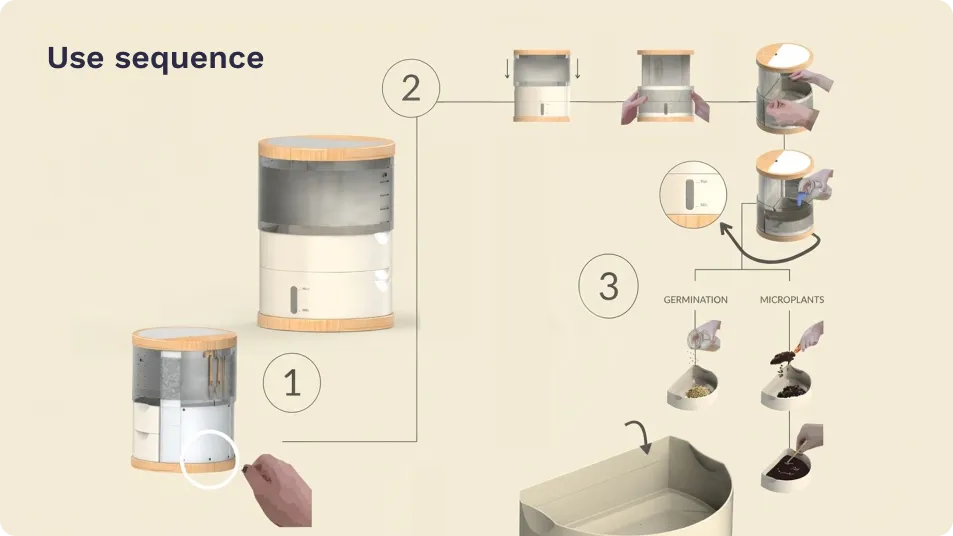
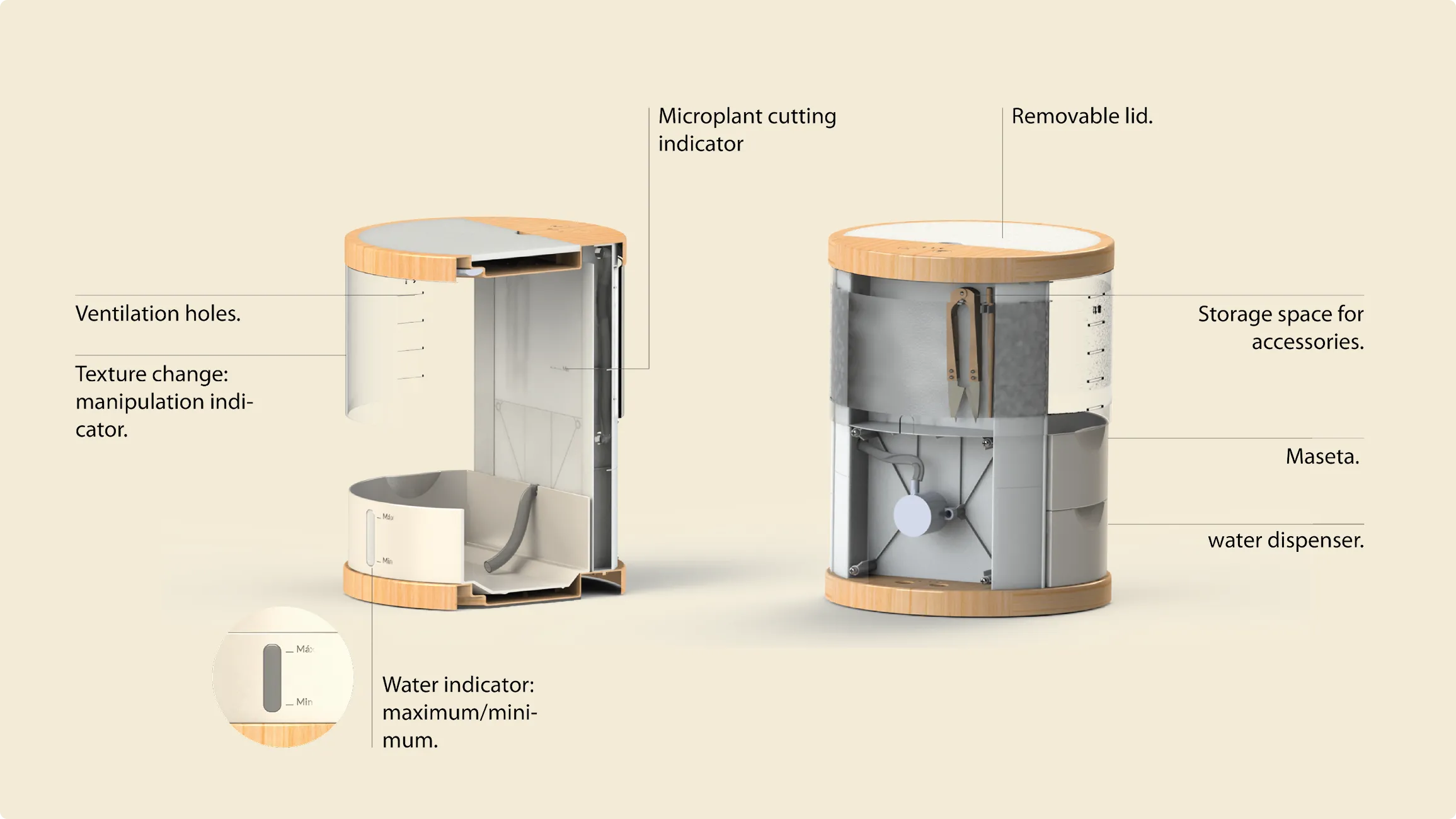
Turns legumes and cereals into ready-to-eat food without cooking. For germination, a closed, light-blocking container keeps humidity and temperature right during a 3-day cycle. For microgreens, seeds grow in a perforated pot with automated watering over 6 days. The water falls like rain, and an LED light turns on when the plants need it.
06Product development
Composition
Both products share the same structure: a base and a lid that close the product, a container for the food (strainer or pot) and a transparent part to watch the process (jar or door).
Materials and production
We first wanted noble regional materials like wood and ceramic. But at a production of 30,000 units, they were too expensive and wasteful to process for a cylindrical form. We resolved the products in injection-molded plastic, with few parts and only two materials (LDPE and PP), with a wood-like finish on the base and lid. Bioplastic would be the ideal next step.
Color
A reduced palette, so the many colors of legumes and cereals stand out, based on the neutral tones we found in kitchens: white with light wood, and black with dark wood.
07Prototype & reflection
Prototype
We built a 3D-printed prototype to verify dimensions, ergonomics and how the parts work together. It had no motor, so it tested the form and functions, not the automated watering.
What I learned
We started from a broad topic, nutritional deficiency and its effect on health, and found the real design opportunity through research. The project taught me to balance ideals with production reality, like giving up noble materials to make the product viable. And it showed me that a product alone wasn’t enough: users also needed guidance, which is why we always imagined an app as part of the family.